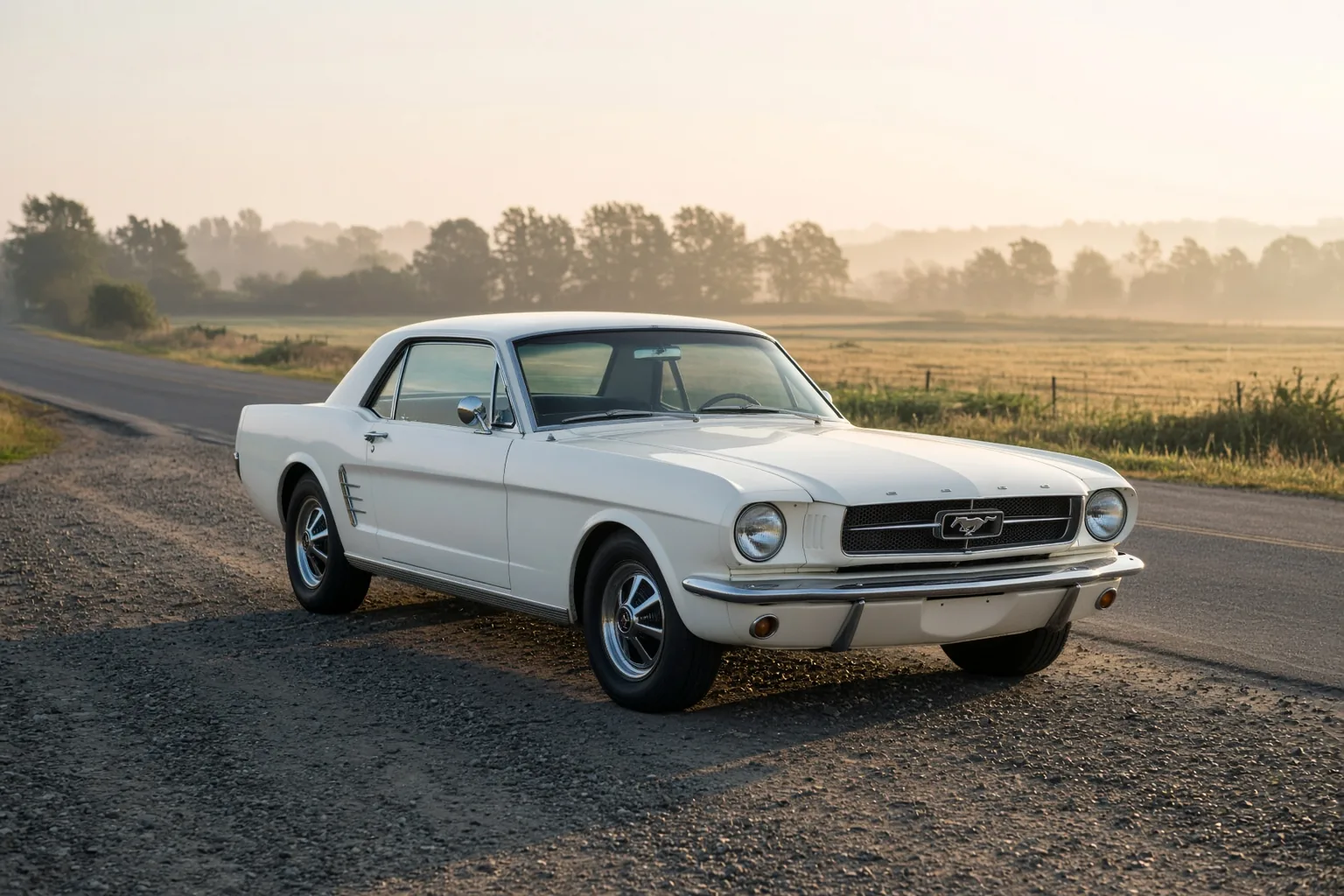
Ford introduced the Mustang on 17 April 1964, at the New York World's Fair. Every one was titled by Ford as a 1965 model, though collectors still call the first 121,538 of them 1964½s. Ford expected to sell fewer than 100,000 a year. It passed that figure in three months, and more than 400,000 found homes in the first year.
The designer favoured the name Cougar. Focus groups disagreed, choosing Mustang by a wide margin, and the car went on to lend its name to an entire class of cars, the pony car. Underneath sat familiar hardware — chassis, suspension and drivetrain from the sensible Falcon, which held the price to $2,368 — beneath a body that was entirely new: a long bonnet, a short deck, side scoops, bucket seats, a floor-mounted gear lever.
Hardtop and convertible came first, the fastback following in September 1964 with a sweeping tail that owed something to the Jaguar E-Type coupé. Engines ran from a modest 170 cubic inch six to the 289 V8; the rare K-code HiPo 289, offered from June 1964, made 271 horsepower. A fully equipped V8 car weighed about 3,000 lb, light by any measure. Drive one today and the small things charm first: the padded dashboard, the glove box light, the low seating position.
“The shared Falcon parts are a quiet blessing now.”
The car grew with its audience. The 1967 facelift brought more size and the first big-block option; 1968 a new 302 V8; 1969 the wide-shouldered restyle with quad headlamps, the Mach 1 and the Boss 302. The 1970 models calmed the face again. Each has its partisans. The purest shape, most agree, is the original.
The shared Falcon parts are a quiet blessing now. Sixty years on, the first-generation Mustang remains one of the friendlier classics to keep running. Our listings include a healthy herd of them, from the earliest 1965 cars to the later, heavier restyles. It is worth an evening just to look.


